

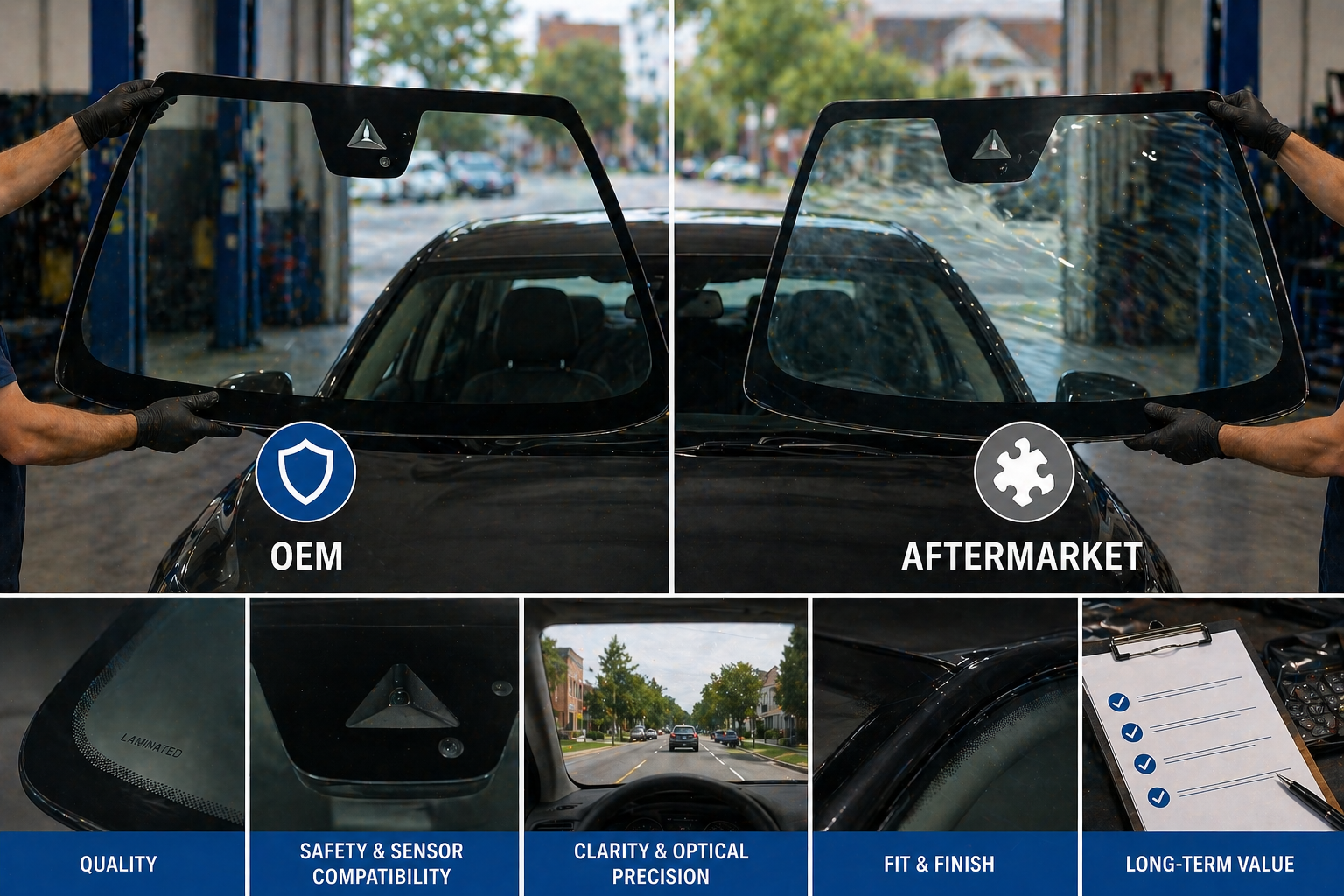
When it’s time to replace a cracked or damaged windshield, one of the first decisions you’ll face is a choice most drivers have never thought about before: OEM or aftermarket glass? Understanding the difference between OEM vs. aftermarket windshield glass can help you make a confident, informed decision — one that balances quality, safety, and cost in a way that makes sense for your vehicle and your budget.
At Low Price Auto Glass in Hammond, Indiana, we’ve been helping drivers throughout the area get quality windshield replacements at fair prices for years. We work on all makes and models, carry one of the largest in-house glass inventories in the region, and believe that every customer deserves a straight, honest explanation of their options before any work begins. This guide gives you exactly that.
What Does OEM Mean — and What Does Aftermarket Mean?
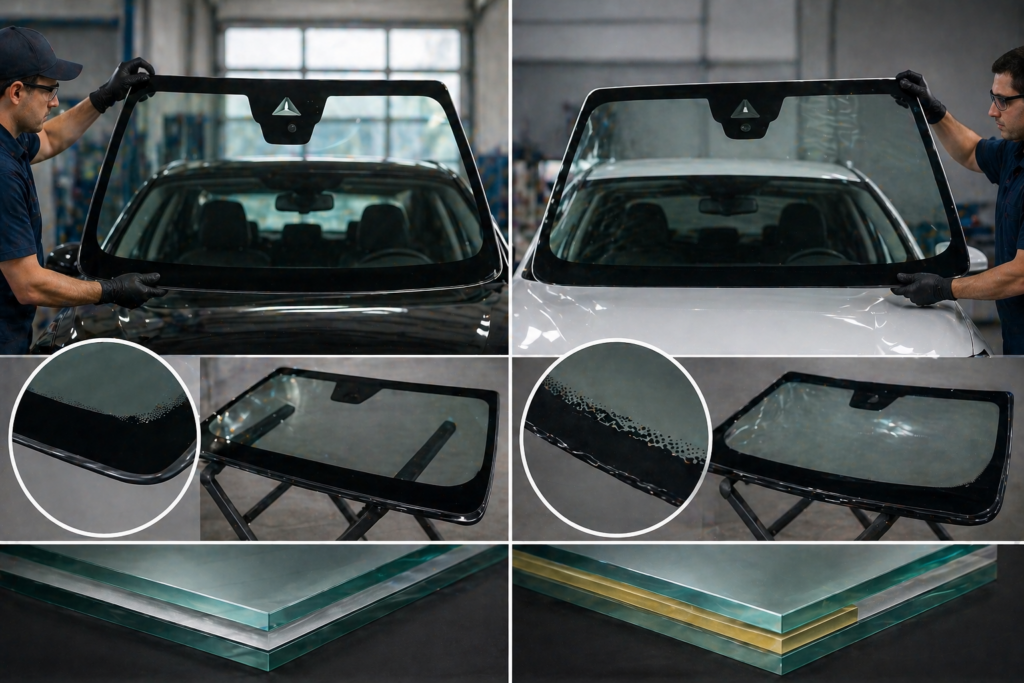
OEM stands for Original Equipment Manufacturer. An OEM windshield is either made by the same manufacturer that supplied the original glass for your vehicle, or produced to the exact specifications provided by your vehicle’s automaker. In either case, it is the closest possible match to the windshield your car, truck, or SUV came with when it rolled off the assembly line.
Aftermarket glass is produced by independent manufacturers who are not the original supplier for your vehicle’s brand. These manufacturers create windshields designed to fit a wide range of vehicle makes and models, producing glass to meet — and in some cases exceed — industry safety standards. The aftermarket auto glass industry is large, well-regulated, and dominated by established manufacturers whose products are installed in millions of vehicles every year.
Neither option is automatically better than the other. The right choice depends on your vehicle, your priorities, and your specific situation — and a good auto glass shop will help you understand both before making a recommendation.
How OEM Windshield Glass Is Made and What It Guarantees
OEM windshields are manufactured under direct specification from the vehicle’s automaker. Every measurement — the curvature of the glass, its precise thickness, the composition of the laminate layers, the tint percentage, the placement of any embedded elements — is determined by the same engineering team that designed the vehicle. When you install an OEM windshield, you are restoring the vehicle to its factory-original configuration with the highest possible confidence in fit and performance.
For vehicles that came equipped with integrated features such as built-in defrost elements, rain sensors, embedded antennas, heads-up display (HUD) compatibility, or acoustic interlayers for noise reduction, OEM glass preserves those features exactly as designed. There is no guesswork about compatibility, and no risk that a factory feature will behave differently after the replacement.
OEM glass also carries the vehicle manufacturer’s endorsement — which matters if your vehicle is still under a manufacturer’s warranty, or if your insurance policy includes an OEM glass endorsement that requires original-specification glass for covered replacements.
How Quality Aftermarket Windshield Glass Compares
The aftermarket auto glass industry is subject to strict safety standards. In the United States, auto glass manufacturers must comply with Federal Motor Vehicle Safety Standard (FMVSS) 205, which governs the optical quality, impact resistance, and structural performance of automotive glass. Reputable aftermarket manufacturers design their windshields to meet or exceed these standards — which means that quality aftermarket glass is genuinely safe and structurally sound for the vast majority of vehicle applications.
The advantages of aftermarket glass are primarily practical. It is significantly less expensive than OEM glass — often by a substantial margin — and it is more readily available, which supports same-day replacement service. For drivers whose vehicles are out of warranty, whose insurance policies don’t specify OEM glass, or who simply want a high-quality replacement at the best possible price, aftermarket glass is a well-established and sensible choice.
Where quality aftermarket glass occasionally falls short of OEM is in the finer tolerances: minor variations in curvature, slight differences in optical clarity, or small discrepancies in the fit of moldings and trim. In practice, these differences are rarely noticeable in everyday driving — but they are worth understanding, particularly for newer vehicles with tight factory tolerances or specialized windshield features.
The ADAS Factor: Why Glass Quality Matters More Than It Used To
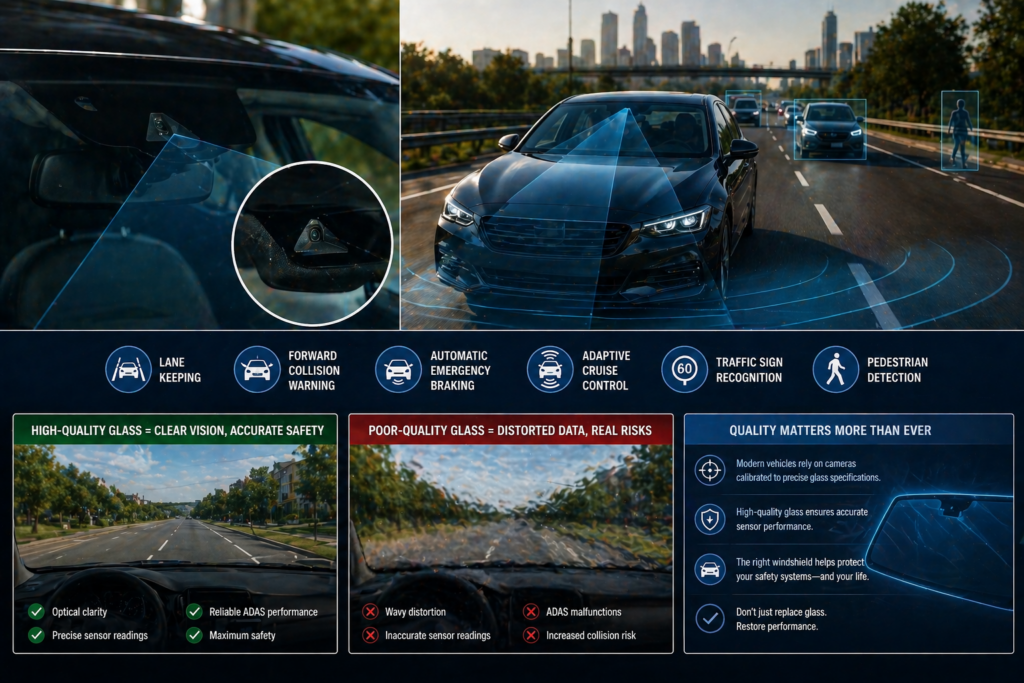
For older vehicles without driver assistance technology, the OEM vs. aftermarket decision is largely about fit, finish, and cost. For modern vehicles equipped with ADAS — Advanced Driver Assistance Systems — it carries an additional dimension that is worth taking seriously.
Many of today’s vehicles mount a forward-facing camera at the top of the windshield to support features like lane departure warning, automatic emergency braking, and adaptive cruise control. The accuracy of these systems depends in part on the optical consistency of the glass through which the camera is viewing the road. Windshields with inconsistent optical clarity, uneven thickness, or slight distortions can introduce errors into the camera’s data — errors that may be small enough to go unnoticed in daily driving but significant enough to affect system performance when it matters most.
This is why, for vehicles with ADAS cameras, glass quality is not just a comfort consideration — it is a safety one. High-quality aftermarket glass produced to OEM-equivalent optical standards will not compromise your ADAS systems. Lower-grade glass may. At Low Price Auto Glass in Hammond, we use only quality-verified replacement glass and recommend ADAS recalibration after windshield replacement on any vehicle that requires it, ensuring your safety systems are restored to their proper operating condition.
Which Option Is Right for Your Vehicle?
There is no universal answer, but here is a practical framework for thinking through the decision:
- Your vehicle is under manufacturer warranty. OEM glass is the safer choice. Some manufacturers specify that warranty coverage on related components may be affected by non-OEM parts. Confirm with your dealer before choosing aftermarket.
- Your insurance policy includes an OEM endorsement. If you’re already paying for OEM glass coverage, use it. Your insurer will cover the cost of OEM glass for the replacement, and you get factory-original quality at no additional out-of-pocket expense.
- Your vehicle has specialized windshield features. HUD-compatible windshields, acoustic glass, or precision rain sensors are more sensitive to fit and optical consistency. OEM glass eliminates any compatibility uncertainty for these applications.
- Your vehicle is out of warranty and has standard features. Quality aftermarket glass is an excellent choice. The performance difference from OEM is minimal for most everyday vehicles, and the cost savings are real — often enough to bring the total replacement cost below your insurance deductible.
- You want the best price without sacrificing quality. This is exactly what Low Price Auto Glass is built to deliver. We’ll match you with the right glass for your vehicle — OEM when it’s warranted, quality aftermarket when it offers equal value — and give you an honest recommendation either way.
A Note on Cost: Why Aftermarket Often Makes Financial Sense
OEM windshields are more expensive than aftermarket glass — sometimes significantly so, depending on the vehicle make, model, and the complexity of any integrated features. For many drivers in the Hammond area, the all-in cost of a quality aftermarket windshield replacement at Low Price Auto Glass comes in below the cost of their comprehensive insurance deductible. When that’s the case, paying directly is faster, simpler, and leaves no claim on your insurance record.
We offer free estimates and transparent pricing on both OEM and aftermarket options. Our goal is to make sure you understand exactly what you’re getting and exactly what it costs — no surprises, no pressure.
Frequently Asked Questions About OEM vs. Aftermarket Windshield Glass
Is OEM windshield glass always better than aftermarket?
Not necessarily. OEM glass guarantees a factory-exact fit and preserves integrated features with certainty. High-quality aftermarket glass from a reputable manufacturer offers comparable safety and performance for most vehicles at a lower price. The right choice depends on your vehicle’s age, warranty status, and specific features.
Will aftermarket windshield glass affect my ADAS safety systems?
Quality aftermarket glass produced to OEM-equivalent optical specifications will not interfere with ADAS cameras or sensors. Lower-grade glass with optical inconsistencies can. This is why sourcing glass from a reputable supplier — and ensuring ADAS recalibration is performed after replacement on equipped vehicles — matters for safety.
Does my insurance require OEM glass for windshield replacement?
Most standard comprehensive policies default to aftermarket glass. OEM glass is typically required only if your policy includes a specific OEM glass endorsement. If you prefer OEM, ask your agent about adding this coverage — it is available from many carriers for a modest additional premium.
How can I tell if my replacement windshield is OEM or aftermarket?
OEM windshields carry both the glass manufacturer’s logo and the vehicle brand’s mark. Aftermarket windshields display only the aftermarket manufacturer’s logo. Your technician can confirm which glass is being installed before any work begins.
Does aftermarket windshield glass come with a warranty?
Yes — quality aftermarket glass is backed by a manufacturer’s material warranty, and reputable shops like Low Price Auto Glass also provide a workmanship warranty on the installation. We’ll explain exactly what’s covered before service begins.
Is OEM windshield glass worth the extra cost?
For most everyday vehicles, high-quality aftermarket glass delivers comparable performance at a meaningfully lower price. OEM is most worth the premium for vehicles under manufacturer warranty, those with specialized windshield technologies, or when covered by an OEM insurance endorsement.
Quality and Fit Matter More Than the Label
Whether you choose OEM or aftermarket glass, the most important factors in a successful windshield replacement are the quality of the glass itself and the skill of the technician installing it. A perfectly sourced OEM windshield installed incorrectly is less safe than a high-quality aftermarket windshield installed by an experienced, careful technician — and the reverse is equally true.
At Low Price Auto Glass in Hammond, Indiana, we’ve built our reputation on getting both of those things right for every customer. We carry a large in-house inventory of quality glass for all makes and models, offer same-day service in most cases, work with all major insurance carriers, and price our services to be genuinely affordable — often below the cost of a standard insurance deductible. Call us today for a free estimate and let us help you find the right windshield for your vehicle at the best price in the area.
Comments are closed.