

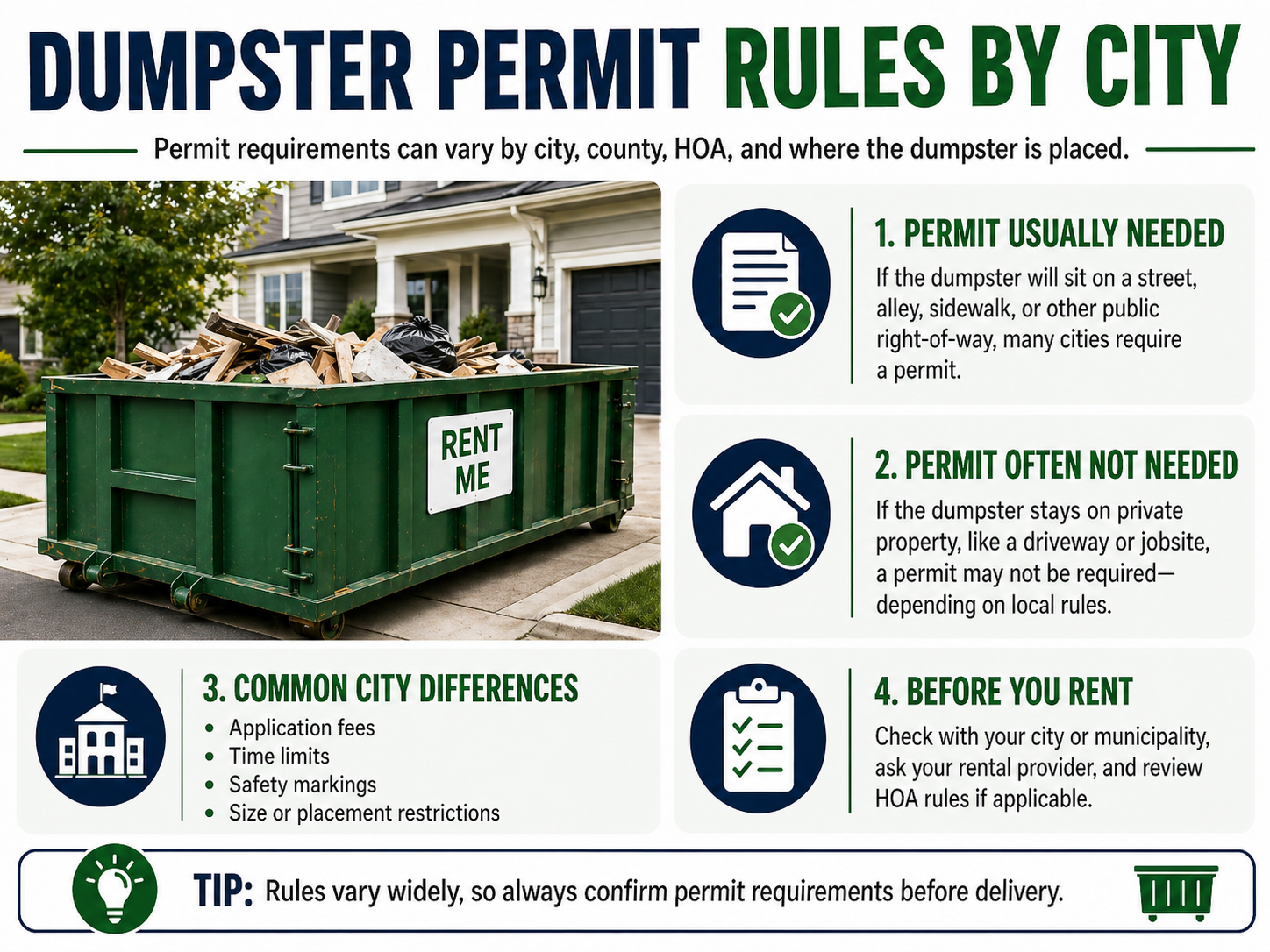
Before you schedule a dumpster delivery, there’s one question that trips up a lot of homeowners and contractors: do you need a permit? The answer depends almost entirely on where the dumpster will sit — and dumpster permit rules by city can vary more than most people expect. One neighborhood may require nothing more than a phone call, while the next city over could have a formal application process, fees, and a waiting period before your container is allowed on the street.
At Dump IT LLC, we’ve helped Indianapolis-area homeowners, contractors, and businesses navigate dumpster placement for years. This guide covers everything you need to know — when permits are required, how the rules differ from city to city, what the permit process looks like, and how to position your dumpster to stay fully compliant from delivery to pickup.
A Permit Is Required Any Time the Dumpster Goes on Public Property
The single most reliable rule across nearly every city in the United States: if your dumpster will be placed on public property — a street, sidewalk, alley, or right-of-way — you almost certainly need a permit. The reasoning is straightforward. Public roads and sidewalks are managed by the city, and placing a large container on them can affect traffic flow, pedestrian safety, and emergency vehicle access.
Private property is a different story. If your dumpster will sit entirely on your driveway, yard, or private parking area, most municipalities don’t require any permit at all. The key factors that typically trigger a permit requirement include:
- Placement on a public street or curb lane
- Placement on a public sidewalk or shared walkway
- Placement in a public alley
- Any location within the city’s right-of-way, even partially
- Placement near an intersection, crosswalk, or fire hydrant
When in doubt, err on the side of applying for a permit. The cost of a permit is almost always less than the fine for placing a container without one.
Permit Rules Vary Significantly from City to City
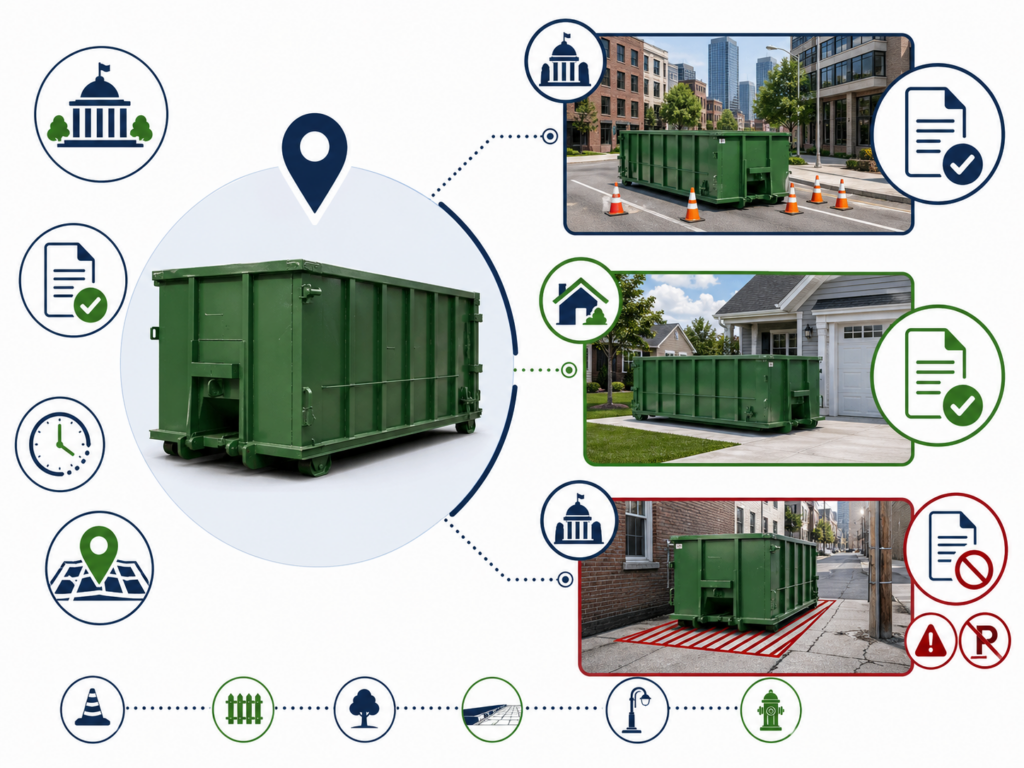
There is no single national standard for dumpster permits — every city and county sets its own rules. What’s allowed in one zip code may be prohibited two miles away. Understanding this patchwork of regulations is essential for anyone managing a project that spans multiple locations, or for contractors working across city and county lines.
Here’s a general breakdown of how permit requirements tend to differ by municipality:
- Permit fee: Ranges from free (in some smaller towns) to $25–$150 or more in larger cities. Some cities charge by the day; others charge a flat fee for the rental period.
- Application method: Larger cities often have online portals for permit applications. Smaller municipalities may require an in-person visit to the city clerk or public works department.
- Processing time: Same-day approval is possible in some cities; others require 3–5 business days.
- Placement restrictions: Many cities prohibit dumpsters within a certain distance of fire hydrants, intersections, or bus stops — typically 10 to 25 feet.
- Duration limits: Some municipalities cap how long a permitted dumpster can remain on public property — often 7 to 14 days — after which you must renew the permit or move the container.
- Safety requirements: Most cities require reflective cones, safety lights, or barricades around any dumpster placed on a public street after dark.
What Does a Dumpster Permit Actually Cover?
A dumpster permit is essentially the city’s written authorization to temporarily occupy public space with a large container. It protects you legally, ensures the city knows the container is there, and sets the terms for how long it can stay and under what conditions.
A standard permit will typically specify:
- The approved placement location (address and street side)
- The permitted start and end date for the container
- Any safety measures required (cones, lights, markings)
- The maximum container size allowed at that location
- Contact information for both the permit holder and the rental company
Some cities issue permits directly to the homeowner; others issue them to the dumpster rental company on the customer’s behalf. When you book with Dump IT LLC, our team can clarify which applies in your area and what documentation you’ll need to have ready.
Indianapolis Dumpster Permit Requirements: What Local Customers Need to Know
For customers in Indianapolis and the surrounding Marion County area, permit requirements follow the city’s standard right-of-way ordinances. In general, dumpsters placed entirely on private property do not require a permit. Containers that extend onto the street, curb lane, or public sidewalk fall under the city’s right-of-way permit process, managed through the Department of Public Works.
Key points for Indianapolis-area dumpster placements:
- Right-of-way permits are required for any container placed in a public street or on a city sidewalk
- Applications are typically submitted through the city’s online permitting portal or in person at the DPW office
- Safety lighting and reflective cones are required for street-placed containers when visible after dark
- Suburban cities around Indianapolis — including Carmel, Fishers, Noblesville, Greenwood, and Avon — each have their own permit offices and may have different fee structures or processing times
Because Dump IT LLC operates throughout the Indianapolis metro area, our team is familiar with the permit landscape across these communities and can help you determine the right placement strategy for your address before delivery day.
How to Get a Dumpster Permit in Your City
The permit process is simpler than most people expect. Here’s a step-by-step approach that works in most municipalities:
- Determine your placement location. Decide exactly where the dumpster will sit. If it will be entirely on private property, you likely don’t need a permit — confirm this with your rental company or city directly.
- Contact your city’s public works or permit office. Search “[your city] right-of-way permit” or “[your city] dumpster permit” to find the right department. Most cities have this information on their official website.
- Submit your application. Provide the placement address, requested dates, container size, and rental company information. Pay any applicable fees.
- Receive your permit before delivery. Don’t schedule your dumpster delivery until the permit is in hand. Placing a container before a permit is approved puts you at risk for fines and forced removal.
- Post or keep the permit accessible. Some cities require the permit to be visibly displayed on or near the container. Others simply want it on file with the rental company. Check your permit’s specific instructions.
- Note the expiration date. If your project runs longer than the permit allows, apply for a renewal before it expires — not after.
You Can Often Avoid a Permit Entirely — Here’s How
The easiest way to sidestep the permit process is to place your dumpster on private property. For most residential projects, this is entirely doable with a little planning.
Practical options that typically don’t require a permit:
- Your driveway: The most common placement option for residential rentals. A standard driveway can accommodate a 15- or 20-yard dumpster without any overhang onto the street.
- Your yard or side yard: If driveway access is limited, a gravel or packed-dirt side yard can work. Use plywood boards under the container to protect soft ground or finished surfaces.
- A private parking lot: For commercial projects, placing the container in a privately owned lot eliminates the need for a right-of-way permit entirely.
- A back alley on private property: Some properties back up to a private alley or easement — confirm ownership before placing the container there.
Choosing the right dumpster size also helps. A 15-yard container fits on most standard driveways without any street overhang, while a 40-yard container may require street placement at some properties. Discussing your layout with Dump IT LLC at the time of booking helps us recommend the best fit.
Frequently Asked Questions About Dumpster Permit Rules
Do I need a permit to rent a dumpster?
It depends on where the dumpster will be placed. If the container sits entirely on your private property — such as a driveway or yard — a permit is generally not required. If it needs to be placed on a public street, sidewalk, or right-of-way, most cities require a permit before delivery.
How much does a dumpster permit cost?
Dumpster permit fees vary widely by city. In many U.S. cities, fees range from $25 to $150 for a standard residential placement. Some municipalities charge more for longer placement periods or larger containers. Contact your local city or county public works office for exact current pricing.
How long does it take to get a dumpster permit?
Processing times vary by municipality. Some cities issue permits same-day or within 24 hours through online portals, while others require 3 to 5 business days. Always apply for your permit before scheduling your delivery to avoid delays on project day.
What happens if I place a dumpster without a required permit?
Placing a dumpster on public property without the required permit can result in fines, forced removal of the container, or both. In some cities, the rental company may face penalties as well. Checking requirements upfront protects your project timeline and your wallet.
Does Dump IT LLC help with dumpster permits in Indianapolis?
When you book with Dump IT LLC, our team can advise you on whether your planned placement location is likely to require a permit. We’re familiar with the requirements across Indianapolis and the surrounding communities, and we’ll help you plan your delivery to stay compliant from day one.
Know the Rules Before the Dumpster Arrives
Dumpster permit rules by city aren’t designed to make your life harder — they’re in place to keep streets safe and projects running smoothly. Taking fifteen minutes to check your local requirements before booking can save you from fines, forced removals, and unnecessary project delays.
At Dump IT LLC, we make the whole process straightforward. From choosing the right container size to planning the best placement for your property, our team is here to help every step of the way. Call us at (317) 253-3100 or book your dumpster online today — and get your Indianapolis project moving with a partner who knows the area inside and out.
Comments are closed.